Compressed air management
Electricity Management
OEE
Predictive maintenance
Water management

A new industry survey just confirmed something that’s been building for a while: artificial intelligence isn’t only changing how companies work, it’s changing how much electricity the world needs, and how hard that electricity is to get.
Reuters Insights and Rystad Energy surveyed 148 senior energy executives across North America, Europe, the Middle East, Asia, and Latin America for their 2026 report, “Powering the AI Era.” The findings are a useful reality check for anyone running an industrial facility, even one that has nothing to do with artificial intelligence.
The headline numbers are stark. 89% of energy executives expect AI and data center growth to have a material impact on electricity demand in their primary market over the next five to ten years. 91% say their organization is already exploring or actively engaged in data center or hyperscaler projects — in other words, the “wait and see” phase is over.
But the same executives are far less confident about the system meant to deliver all that power. Only 6% describe themselves as “extremely confident” that the grid in their primary market can meet projected data center demand without significant reliability issues. 51% rank energy supply as one of the most significant constraints on data center expansion, right alongside grid interconnection delays, permitting, and equipment availability.
That gap: high confidence in the business opportunity, low confidence in the infrastructure, is the real story of the report.
It’s tempting to read this as a story about hyperscalers and cloud providers, not industrial manufacturers. That’s only half true.
Data centers don’t get their own private power grid. In most regions, they draw from the same transmission lines, the same substations, and the same limited pool of new generation capacity as every other electricity user, including manufacturing plants. When AI infrastructure competes harder for scarce grid capacity, that competition doesn’t stay contained to the tech sector. It shows up as longer interconnection queues, slower permitting for new or upgraded connections, and tighter availability of the equipment utilities need to expand capacity for everyone.
That’s not a hypothetical. It’s consistent with what many manufacturers are already noticing on their own sites: connection upgrades that used to take months now taking years, and equipment orders sitting in longer queues than they used to. The survey backs this up directly — it isn’t AI-specific delays executives are describing, it’s system-wide capacity constraints that any industrial site looking to expand, electrify, or upgrade its connection is increasingly likely to run into.
According to the surveyed executives, three constraints stand out as the most serious barriers to meeting rising electricity demand over the next five years:
None of these are problems that get solved quickly. Building new transmission infrastructure, expanding substations, and manufacturing high-voltage equipment all operate on multi-year timelines — while demand, driven by AI adoption, is moving in months.
This is where the report’s findings translate into something directly actionable for industrial energy management.
If getting more electricity capacity is slower, costlier, and less certain than it used to be, then not needing that additional capacity in the first place becomes a genuinely strategic advantage, not just a cost-saving measure. The fastest megawatt available to any manufacturer is still the one it never had to generate or connect to in the first place.
That reframes what a machine-level energy management system is actually for. It’s easy to think of energy monitoring as a way to trim a utility bill. In a market where grid capacity itself is becoming the constraint, it’s also a way to reduce a facility’s exposure to a system that’s visibly under more pressure than it used to be — by using the capacity already available more precisely, catching waste before it compounds, and making a stronger case internally for why efficiency investment deserves priority.
The report also points to where the energy industry itself is placing its bets on managing this pressure: 49% of executives say data center demand is increasing focus on grid stability and ancillary services, and AI-and-digital-twin-based tools for grid and asset operations rank among the most cited emerging technologies for managing the transition. The direction of travel, on both the supply side and the demand side, is the same: better visibility into how electricity is actually being used, in real time, at a granular level.
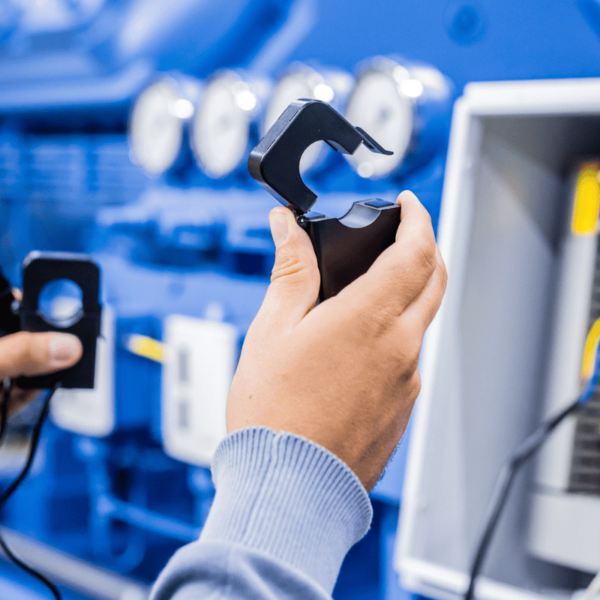
None of this requires waiting for the grid to catch up. A wireless energy management system that monitors electricity consumption at machine level gives a facility exactly the kind of granular visibility the report’s own findings point to as increasingly valuable: knowing precisely where energy is going, catching waste and inefficiency before it adds to a facility’s total draw, and making the most of the capacity already secured rather than assuming more capacity will always be available on request.
Sensorfact’s plug-and-play sensors give manufacturers that visibility without rewiring a facility or waiting on a lengthy installation project. Over 4,000 industrial customers are already using this kind of machine-level monitoring to identify savings — together, Sensorfact customers have identified more than 420 GWh in potential energy savings to date.
As grid capacity becomes a more contested resource, knowing exactly where your electricity goes stops being a nice-to-have. It becomes the fastest, most reliable lever a manufacturer has.
Ready to see where your facility’s energy is really going? Request a demo and find out what a machine-level energy management system can reveal about your plant.
Whether you want to save on energy or avoid maintenance, we can show you how our smart monitoring solution will benefit your plant. Don’t wait any longer and start saving on time and costs right away.
Request a demo